---
title: "Predation Transposed to the Disruptive"
subtitle: "AI Will Benefit No One"
date: 2026-05-02
author: JAS
theme: "IA"
keywords: ["intelligence artificielle", "développeurs", "automatisation", "marché du travail", "prédation numérique", "disruption", "sécurité logicielle", "supply chain IA", "énergie", "capitalisme", "vibe coding"]
image: https://ik.imagekit.io/l2lkwahet/199A/346.jpg
audio: 1
slug: predation-transposed-to-the-disruptive
status: published
faq: [{"q":"What is the core argument of the article regarding AI\\'s impact on society and the economy?","a":"The article argues that AI, as currently deployed, impoverishes societies rather than enriching them. It claims that automated production without scarcity or human know-how drives value toward zero, erodes trust, and burdens infrastructure with bloated code. Ultimately, it concludes that AI benefits no one except a self-expanding system that degrades the material, economic, and cognitive foundations of common life."},{"q":"How does the article describe the transformation of the developer job market and salary trends?","a":"The article notes a structural inflection in the European developer market: junior salaries are plateauing or slightly eroding in real terms around €40–42k gross annually, due to slowing recruitment, abundant junior supply, and AI automation of entry-level tasks. Conversely, senior profiles are expected to see moderate growth from ~€60k today to ~€67k by 2036, as value shifts toward framing, securing, and orchestrating complex systems."},{"q":"What are the key risks and pitfalls identified for organizations adopting AI tools?","a":"The article highlights security flaws, eroded trust, stagnant salaries, and instability in the AI supply chain—including hallucination rates, token outages at Anthropic, and high costs of on-premise porting. It also warns of a disconnect between management and operational teams, leading to pressure on developers and a proliferation of half-finished products and structural vulnerabilities."},{"q":"What evidence does the article provide about the energy consumption of AI infrastructures?","a":"The article cites forecasts from the International Energy Agency that global electricity consumption by AI infrastructures will more than double by 2030, reaching approximately 945 TWh—roughly equivalent to Japan\\'s current consumption. It criticizes the lack of investment in civilian nuclear capacity and the irresponsible postponement of energy planning, despite known fragility in energy prices and scarcity."},{"q":"What does the article say about the qualitative and environmental consequences of AI-generated code?","a":"It describes an inflation of code that is \\'spectacular as it is alarming,\\' with bloated systems diluting the essential in layers of useless abstractions. This code burdens infrastructures, exhausts resources, and makes tools opaque, while AI locks us in a self-referential loop where models train on their own artifacts, mistaking a statistical caricature of the world for reality."},{"q":"How can 199A Consulting help an organization frame or execute on AI strategy in light of these risks?","a":"199A Consulting, with 20+ years of experience, positions itself as a trusted partner for organizations navigating AI\\'s complexities. We provide strategic framing through audits, governance, and risk assessment, and execution via architecture, build, integration, and training—all anchored in digital sovereignty to ensure sustainable, secure, and human-centered outcomes. For a tailored discussion, contact us at business@199a.agency"}]
---
Predation Transposed to the Disruptive
AI Will Benefit No One
The manifest effects of capturing the surplus production enabled by automation, language models, and their forced adoption into the economic model are measurable in both figures and flesh.
From acceleration to exhaustion, only a few months will have passed — the inflection point dating from the remarkable moment when the inclusion of agents in IDEs became commoditized, transforming the average developer into a vertical factory, compressing temporal and qualitative values by a factor of 10 to 100 units.
The industrialization of the means of production and their appropriation, as has been customary since industry first existed, has been accompanied by an unprecedented form of social dumping in that it strikes a new underclass of workers.
Gone are the days — though so recent — when the *"10x"* developer dictated their own terms and salary. They are now silenced, effortlessly surpassed by another who is less concerned with the quality of what they produce, acquiescing to the slightest request, however poorly formulated, a simple relay-multiplier of "product" requirements dreamed up hastily with no ethics or even consideration for security, technical debt, or environmental ethics.
For all these aspects are impacted, at scales that seemingly no one wants to measure. And yet measure there is.
The trend would therefore be to push the limits of sustainability by relying on an ever-present and growing production capacity.
But what exactly are we producing?
Where is this acceleration heading? For while every vector has a starting point, a direction, and a force, the equation remains uncertain today as we do not possess all its variables.
Let us observe the observable and develop some projections.
 Sources [OptimaEurope](https://www.optimaeurope.com/recruitment-blog/how-to-hire-saas-developers-in-europe-2026-guide)
If the analyses are to be believed, the rational scenario tends toward these conclusions:
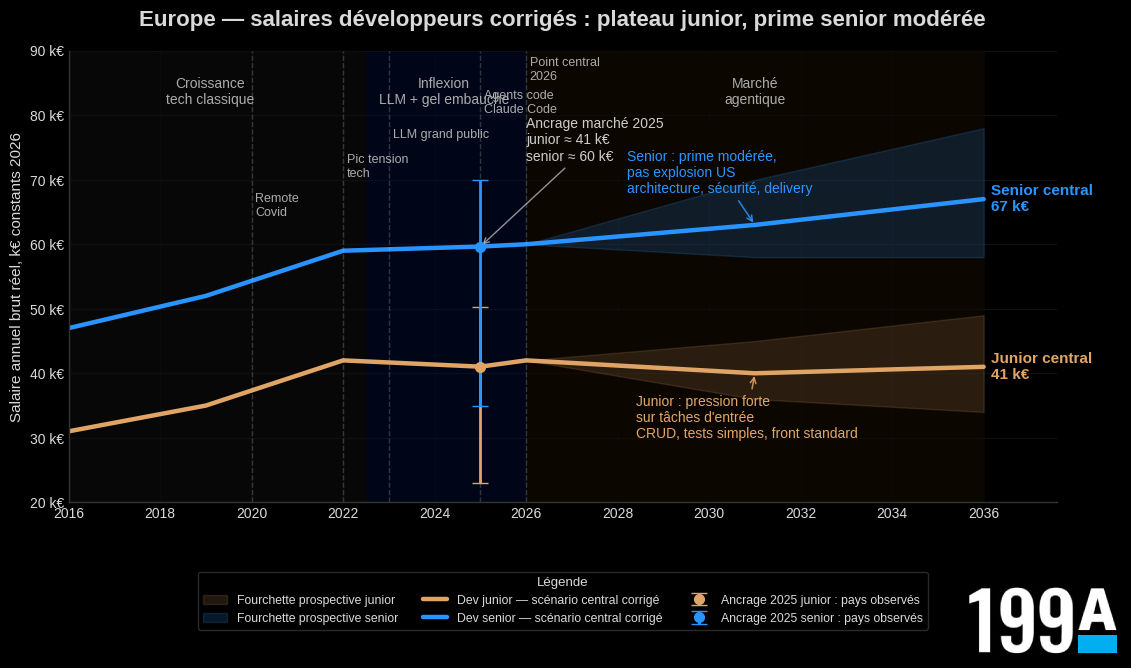
Evidence of a structural inflection in the European developer market — after a phase of salary growth linked to tech tensions up to 2022, junior compensation is entering a plateau logic, or even slight erosion in real terms, around €40–42k gross annually:
- a combination of slowing recruitment
- an abundant junior supply and progressive automation of entry-level tasks by AI tools.
Conversely, senior profiles would maintain a moderate upward trajectory, from around €60k today toward approximately €67k by 2036 in the central scenario, as value shifts toward the ability to frame, secure, integrate, and deliver complex systems.
For an IT department, the operational message should be clear: do not mechanically reduce developer headcount, but reconfigure the skills pyramid — by limiting recruitment of non-augmented juniors, accelerating their path to autonomy via AI, and securing senior profiles capable of orchestrating architectures, software quality, and the productivity of tooled teams.
Yet the observation that can already be made in the friction dynamics between executive and operational levels (particularly HR) is that this balance and skill mix is not being respected, and that pressure on Dev teams and the labor market is already at its peak — while at the same time, framing capabilities are being short-circuited by management as stingy with their time as with their budgets, dreaming of omnipotence since they too are doped on synthetic intelligence. Disconnection.
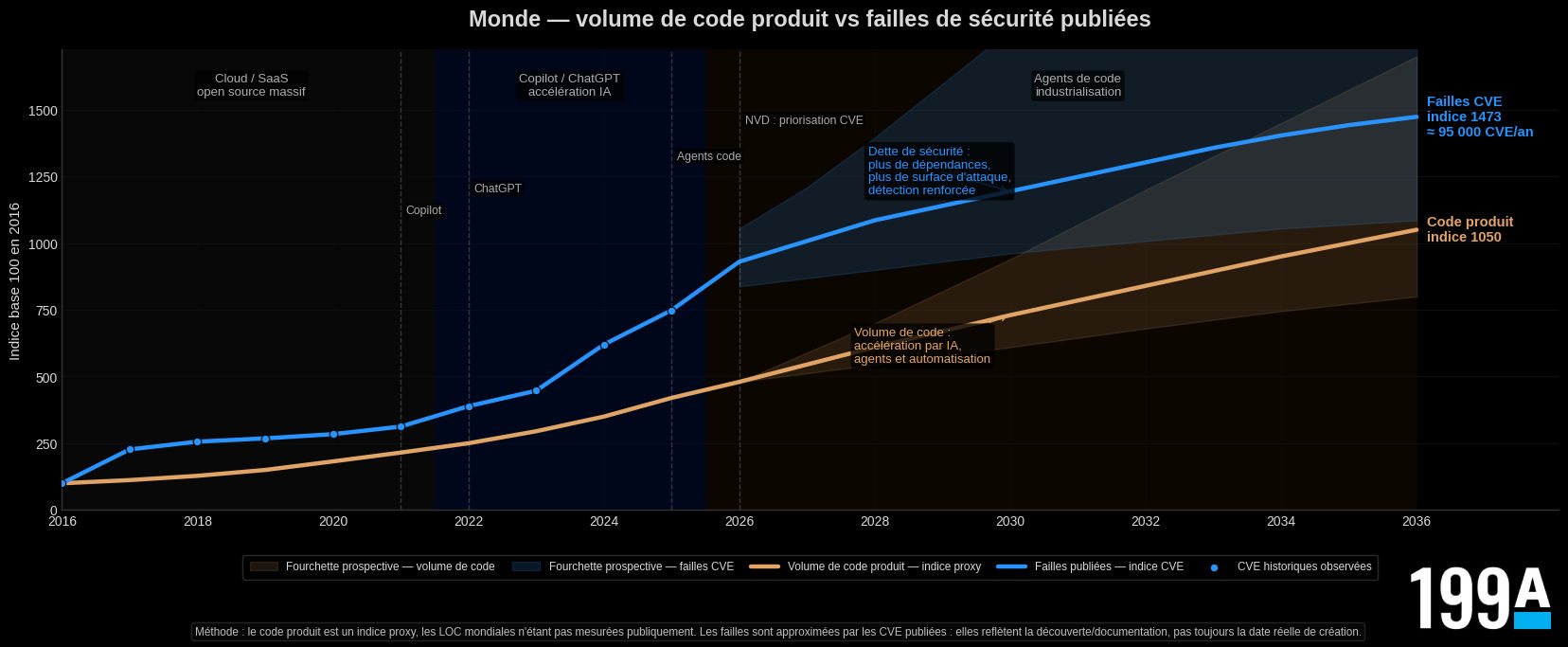
This is evidenced by the proliferation of senior profiles struggling to find assignments, the impossibility for juniors to access the labor market under bearable conditions, the inflation of half-finished products, and the structural security flaws that are multiplying.
On the product side, we create disposable goods, instant deployment, betting on 100 projects to retain just one that is bankable. Pure capitalist logic that leaves a trail of dust and bile in its wake, as trust erodes faster than it is built.
Sources [OptimaEurope](https://www.optimaeurope.com/recruitment-blog/how-to-hire-saas-developers-in-europe-2026-guide)
If the analyses are to be believed, the rational scenario tends toward these conclusions:
Evidence of a structural inflection in the European developer market — after a phase of salary growth linked to tech tensions up to 2022, junior compensation is entering a plateau logic, or even slight erosion in real terms, around €40–42k gross annually:
- a combination of slowing recruitment
- an abundant junior supply and progressive automation of entry-level tasks by AI tools.
Conversely, senior profiles would maintain a moderate upward trajectory, from around €60k today toward approximately €67k by 2036 in the central scenario, as value shifts toward the ability to frame, secure, integrate, and deliver complex systems.
For an IT department, the operational message should be clear: do not mechanically reduce developer headcount, but reconfigure the skills pyramid — by limiting recruitment of non-augmented juniors, accelerating their path to autonomy via AI, and securing senior profiles capable of orchestrating architectures, software quality, and the productivity of tooled teams.
Yet the observation that can already be made in the friction dynamics between executive and operational levels (particularly HR) is that this balance and skill mix is not being respected, and that pressure on Dev teams and the labor market is already at its peak — while at the same time, framing capabilities are being short-circuited by management as stingy with their time as with their budgets, dreaming of omnipotence since they too are doped on synthetic intelligence. Disconnection.
This is evidenced by the proliferation of senior profiles struggling to find assignments, the impossibility for juniors to access the labor market under bearable conditions, the inflation of half-finished products, and the structural security flaws that are multiplying.
On the product side, we create disposable goods, instant deployment, betting on 100 projects to retain just one that is bankable. Pure capitalist logic that leaves a trail of dust and bile in its wake, as trust erodes faster than it is built.
 Qualitatively, several pitfalls have come to shatter the dreamed trajectory of the vibe-coder in a trance;
Security, as we have just seen, eroded trust, stagnant salaries — but above all, and this is what should worry IT departments, it is the instability of the AI supply chain.
Between the fluctuating but never-zero hallucination rate of GPT 5.X, the token outages at Anthropic which caps its infrastructure under the pressure of insatiable demand, the stratospheric costs of on-premise porting which bleeds the few players who can afford it (when they can find and are willing to pay engineers to develop the infrastructure), the ever-growing appeal of Asian brokers at the price of sacrificing all sovereignty and genuine governance — it is difficult to navigate and lay the foundations of a sustainable, industrial-scale model.
Even public actors — those toward whom we should turn when it comes to planning and guaranteeing security — have failed to find their footing, scattering between reassuring declarations ungrounded in any concrete action, confused initiatives, and permanent reorganization.
Qualitatively, several pitfalls have come to shatter the dreamed trajectory of the vibe-coder in a trance;
Security, as we have just seen, eroded trust, stagnant salaries — but above all, and this is what should worry IT departments, it is the instability of the AI supply chain.
Between the fluctuating but never-zero hallucination rate of GPT 5.X, the token outages at Anthropic which caps its infrastructure under the pressure of insatiable demand, the stratospheric costs of on-premise porting which bleeds the few players who can afford it (when they can find and are willing to pay engineers to develop the infrastructure), the ever-growing appeal of Asian brokers at the price of sacrificing all sovereignty and genuine governance — it is difficult to navigate and lay the foundations of a sustainable, industrial-scale model.
Even public actors — those toward whom we should turn when it comes to planning and guaranteeing security — have failed to find their footing, scattering between reassuring declarations ungrounded in any concrete action, confused initiatives, and permanent reorganization.
 Energetically, it is the unknown. We know the appetite of the infrastructures, we measure our fragility in the face of energy prices and their scarcity (war, resources, absurd margins, deregulated actors) — yet we sidestep the question in the most irresponsible manner, putting off until tomorrow what should have been undertaken 20 years ago. No visibility or sign of investment in what once constituted the tip of France's industrial spear — namely its civilian nuclear capacity.
*According to forecasts from the International Energy Agency, global electricity consumption by these infrastructures is expected to more than double by 2030, reaching approximately 945 TWh — roughly equivalent to Japan's current consumption.* — L'Usine Nouvelle, 2025
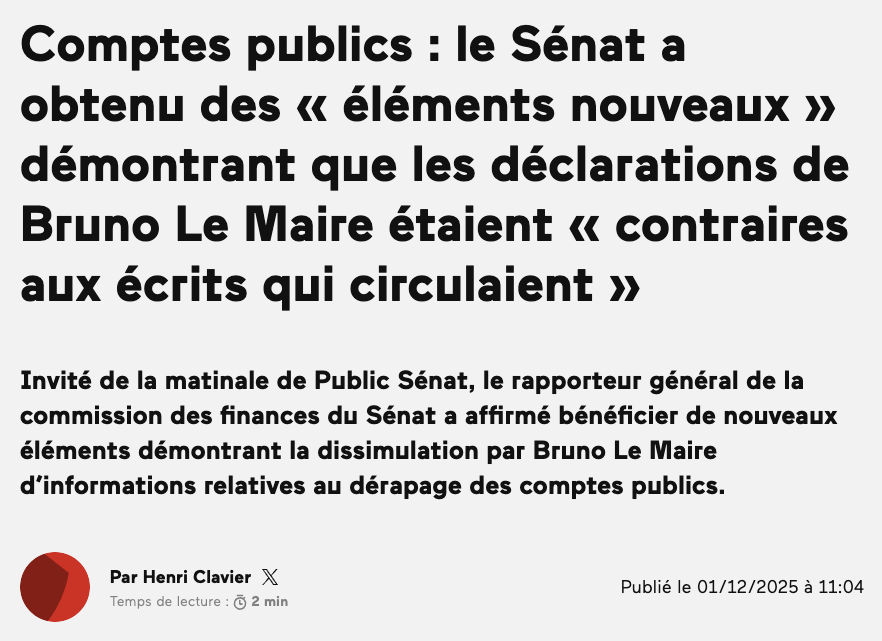
But there is no doubt that Bruno Lemaire has a completely beside-the-point answer on the matter!
Energetically, it is the unknown. We know the appetite of the infrastructures, we measure our fragility in the face of energy prices and their scarcity (war, resources, absurd margins, deregulated actors) — yet we sidestep the question in the most irresponsible manner, putting off until tomorrow what should have been undertaken 20 years ago. No visibility or sign of investment in what once constituted the tip of France's industrial spear — namely its civilian nuclear capacity.
*According to forecasts from the International Energy Agency, global electricity consumption by these infrastructures is expected to more than double by 2030, reaching approximately 945 TWh — roughly equivalent to Japan's current consumption.* — L'Usine Nouvelle, 2025
But there is no doubt that Bruno Lemaire has a completely beside-the-point answer on the matter!
 At the end of this analysis, one conclusion imposes itself in all its starkness: artificial intelligence, as it is being deployed today, does not enrich our societies — it impoverishes them. First, an impoverishment of economic value, drowned in a flood of automated content and services that often only hold worth through the noise they generate. When production happens without effort, without scarcity, and without grounding in human know-how, the price tends toward zero and exchange loses its meaning. The creative economy unravels in an outbidding race to mediocrity, where abundance conceals a net loss of value for the vast majority.
To this is added an inflation of code as spectacular as it is alarming: increasingly bloated systems, written or generated in a logic of saturation, where the essential is diluted in layers of useless abstractions. This code does not build a more sober or more efficient future; it burdens our infrastructures, exhausts our resources, and makes our tools ever more opaque — including for those who produce them.
But the most serious symptom is undoubtedly the disconnection from reality. AI locks us in a self-referential loop, where models train on their own artifacts, where language becomes standardized, where decisions are made on the basis of correlations uprooted from any sensory experience. It is not the world that the machine models — it is a statistical caricature of the world, gradually mistaken for reality itself.
So who truly benefits from this headlong rush?
Neither the workers, whose skills are devalued before being captured. Nor the citizens, confronted with an increasingly toxic information environment. Nor even the businesses, trapped in a technological arms race where competitive advantage evaporates as soon as it is gained. AI will benefit no one, except a system that feeds on its own expansion while eroding the material, economic, and cognitive foundations of common life. The urgency is no longer to accelerate, but to regain our footing.
This article was written by a human, assisted by a few software tools. Not the other way around.
JAS for 199A Consulting - May 2026
At the end of this analysis, one conclusion imposes itself in all its starkness: artificial intelligence, as it is being deployed today, does not enrich our societies — it impoverishes them. First, an impoverishment of economic value, drowned in a flood of automated content and services that often only hold worth through the noise they generate. When production happens without effort, without scarcity, and without grounding in human know-how, the price tends toward zero and exchange loses its meaning. The creative economy unravels in an outbidding race to mediocrity, where abundance conceals a net loss of value for the vast majority.
To this is added an inflation of code as spectacular as it is alarming: increasingly bloated systems, written or generated in a logic of saturation, where the essential is diluted in layers of useless abstractions. This code does not build a more sober or more efficient future; it burdens our infrastructures, exhausts our resources, and makes our tools ever more opaque — including for those who produce them.
But the most serious symptom is undoubtedly the disconnection from reality. AI locks us in a self-referential loop, where models train on their own artifacts, where language becomes standardized, where decisions are made on the basis of correlations uprooted from any sensory experience. It is not the world that the machine models — it is a statistical caricature of the world, gradually mistaken for reality itself.
So who truly benefits from this headlong rush?
Neither the workers, whose skills are devalued before being captured. Nor the citizens, confronted with an increasingly toxic information environment. Nor even the businesses, trapped in a technological arms race where competitive advantage evaporates as soon as it is gained. AI will benefit no one, except a system that feeds on its own expansion while eroding the material, economic, and cognitive foundations of common life. The urgency is no longer to accelerate, but to regain our footing.
This article was written by a human, assisted by a few software tools. Not the other way around.
JAS for 199A Consulting - May 2026